

Your CV stinks!
If you're not getting interviews or call backs .. maybe your CV stinks. How can we unstinkify a resume and make sure it doesn't hit the trash in 1.7 seconds?


How do I know if my CV stinks?
Hiring managers and recruiters see a lot of resumes. Surprisingly for many candidates, they don’t spend a lot of time reviewing each. A 2018 eye tracking study of recruiters said they spent 7.4 seconds reviewing each resume for an initial decision. (Ladders, 2018)
That’s 7.4 seconds on the CV you agonised over for hours. This is close to my experience of reviewing over 100 resumes in one sitting. We would quickly create a small “yes” pile, and a huge “no” pile. I’m sure some of those “no”s were great .. but their CV stunk at telling me they were great.

If you’re updating your resume, think about the role you want. Set a timer and review your resume for 10 seconds. If you don’t quickly see multiple proof points that you’re a great fit for your dream job .. then the hiring manager or recruiter won’t see it either. You know which pile you’ll end up in.
How do you write a CV that doesn’t stink, is effective and has impact in the first quick read?
What makes an effective CV?
An effective CV is one that gets you to the next stage. The next stage is an interview, a conversation about the job, a conversation about your fit or the future. What do hiring managers actually look for in a CV?
Relevant experience. You’ve done this job (or close) before.
Technical fit. You know their tools, systems, and processes.
Scale and complexity. You’ve operated at their level or bigger.
Problem-solving proof. You’ve cracked problems they recognise as hard.
Credentials that matter. The certifications and qualifications their role demands.
Results, not activities. You moved needles, not just turned up.
Cultural signals. You’ll fit how they work (collaboration, autonomy, pace, language).
Career logic. Your next move makes sense; you are not just escaping.
Recruiters look for demonstration of all of these things. What does “Demonstrated” mean? Provable facts. Numbers. Industry relevant language.
What makes an impactful CV?
A great example of an impactful CV is Neil Armstrong’s.
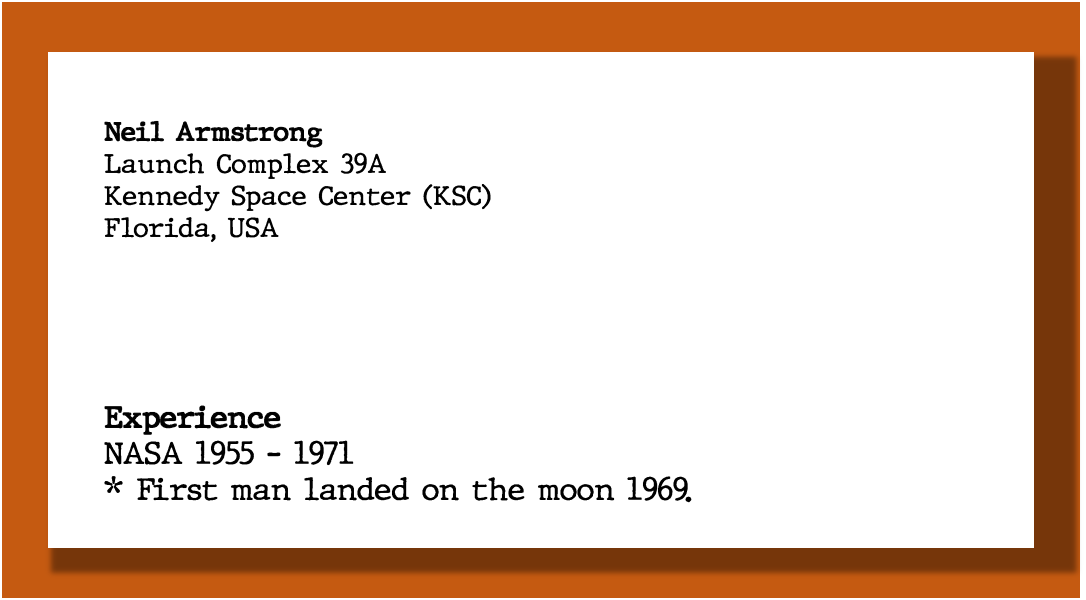
Within second you understand what he’s achieved, understand some of the complexity of his achievements and his role in it.
The evidence you provide under Experience drives the impact of your CV. There’s more to CVs, but the evidence of your experience will make the biggest impact on a go / no-go decision for an interview.
Like Neil Armstrong, you want your evidence to be powerful as “First man landed on the moon 1969”

BUT I am not Neil Armstrong!
Ok. I’m not Neil Armstrong either. The truth is, we have to work a bit harder on our CVs.
If we’re not Neil Armstrong how do we write an effective and impactful CV? I present my Magic CV Evidence Formula.
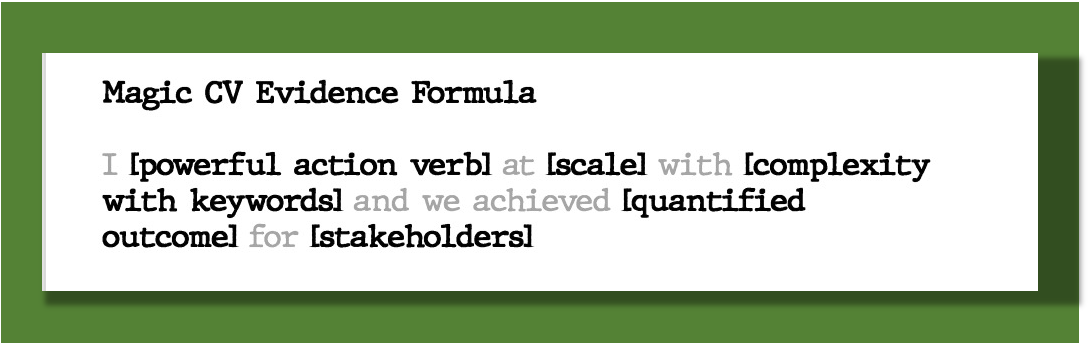
Magic CV Evidence Formula
I [powerful action verb] at [scale] with [complexity with keywords] and we achieved [quantified outcome] for [stakeholders]
The Magic CV Evidence Formula tells your reader: I did this, it was big and complex, and we created these results for these important people. I like the formula because it focuses on something you can prove, and is clear about what you did and what was achieved as a result.
The formula is made up of
[powerful action verb] Choose verbs that signal leadership level and impact. Eg: “managed” is mid-career and “orchestrated” is executive.
[scale] Use numbers to prove you’ve operated at their level. Consider budget, people, customers, geographies, transactions, or timeframes. Eg: 10 FTE, 350 FTE, $1M Budget, $100M, 3 year program, 6 regions.
[complexity with keywords] Show the hard parts. Regulatory pressure, legacy constraints, competing stakeholders, technical debt, or market disruption. Use keywords to weave in the exact technologies, methodologies, standards, soft skills and certifications from your experience relevant to the job requirements.
[quantified outcome] Numbers prove impact - percentages, dollars, time saved, quality improved, or risk eliminated.
[stakeholders] Name who cared about your win. Customers care about experience. Regulators care about compliance. Executives care about results. Boards care about risk and strategy.
The formula is magic because it works. One of the ingredients of the formula is it solves the “I vs We” problem in resume. I see a lot of people soften their CV achievements because they don’t want to take credit for the team’s results. This is valid, but you can solve this by saying what you did with “I [powerful action verb]” and then end with what the team achieved with “we achieved [quantified outcome]”. Mature leaders should know their impact, and what role they played in it .. but also not be delusional that it was all them.
Woven through the Evidence Formula are your keywords. Keywords are your CV’s search engine optimization. Humans scan for patterns and proof. Recruiters and ATS search for keywords. Industry specifics like: SAP, EMR, OPEX, Working Capital Management, Bed Management, Zero Harm, Psychosocial Safety Hazards… these demonstrate you know the business. Miss the keywords, and miss the interview.

Examples: The Magic CV Evidence Formula in Action
Let me share some examples of the Evidence Formula. Read these with a recruiter hat on. Would you recommend the before person progress to interview? The after person? As a bonus question ask yourself: What type of interview questions would I ask the before person compared to the after person? (HINT: Your CV can influence whether you get an interview and the quality of interest)
1. Government
Before: “I was CIO who managed complex IT modernisation improving service delivery”
After: “I led a $45M digital transformation across 12 agencies (2,400 staff), replacing 30-year legacy ERP systems and reducing citizen service times from 14 days to 48 hours while maintaining zero data breaches”
2. Mining
Before: “I was responsible for operations and dealt with challenging production issues and we increased output”
After: “Transformed underperforming underground operation (850 personnel, 24/7) by implementing predictive maintenance on drilling equipment, lifting production 12%, cutting unplanned downtime from 19% to 6%”
3. Consulting
Before: “I was senior consultant who delivered difficult client engagements and achieved business outcomes”
After: “I led enterprise architecture roadmap for ASX-listed retailer ($2.3B revenue) navigating omnichannel disruption and 15% market share loss. Identified $127M cost reduction opportunities and secured Board approval for 3-year transformation program”
4. Infrastructure
Before: “I was program director who managed complex smart meter rollout and we completed successfully on time and budget”
After: “Directed state-wide smart meter deployment (480,000 premises, $180M budget) leading 6 delivery partners, achieving 99.2% first time install success rate and enabling $34M annual OPEX savings”
5. Academia
Before: “I was technology leader who modernized university systems and improved student experience”
After: “Led cloud migration for 45,000-student university, transitioning 120+ applications from on-premise to Azure while maintaining 99.9% availability, enabling $2.8M savings and 40% faster student portal response times”
6. Financial Services
Before: “I was head of digital who implemented new platforms and we achieved regulatory compliance”
After: “Architected API-first banking platform serving 340,000 customers, integrating legacy core banking systems with modern microservices architecture, achieving APRA CPS 234 compliance 4 months ahead of schedule while reducing transaction processing costs by 38%”

Final Thoughts
Think high impact in a 10 second review. Your CV has less than 10 seconds to have an impact. Your evidence lines should be 1 to 3 lines long. I tend to have one or two 3 line items, and mostly 2 liners in my most recent (5-10 years) experience. After that try to get to one line long. Ariel 12pts is roughly 15-18 words a line, so you don’t have many words to create the impact you need. If you get this right the hiring manager or recruiter will then take more time to review and get you in for a conversation.
Leveling up your evidence lines. I’ll write a bit more about the power of keywords and names. These are important for ATS .. but frankly keywords are how our brains work. We want to see what we recognise. I’ll also provide some more examples in the future to help. But the core is the Magic Evidence Formula. Use it. Practice it.
Also check out Colin Lernell’s great video based on science* and reviews of 125,000 resumes. It’s good (* it’s good but it’s probably not science).
What else? You evidence lines are very important but not everything. I have some ideas for the rest of the CV, introductions, cover letters and networking to multiply the power of your new CV.
CV Template - Free to download
I’ll put one in place soon. I want to post this, but let me know if you need one right now.
Consulting Power Point Template - Free to download
As well as CVs I have a set of example business slides in my Free to use Business Template. My aim is to help new managers and consultants communicate better. Download, use it, and have fun writing.
Hey Mark,
I'm glad you're back to writing and targeting the CV topic, as mentioned in your previous comments!
I think your examples are great for understanding what 'results' are.
However, if you never really thought about quantifying your work results in previous jobs and were more focused on being 'responsible for', it's kind of hard to change that mindset since you probably never measured those numbers. And now you dont have the possibility to do so.
What would you recommend for those situations?